
Linen couche alternative for commercial bakeries
Linen couche is the traditional surface for proofing baguettes. In daily production it has two problems: it absorbs moisture and is hard to keep clean, and every loaf still moves to the oven by hand.
Short answer
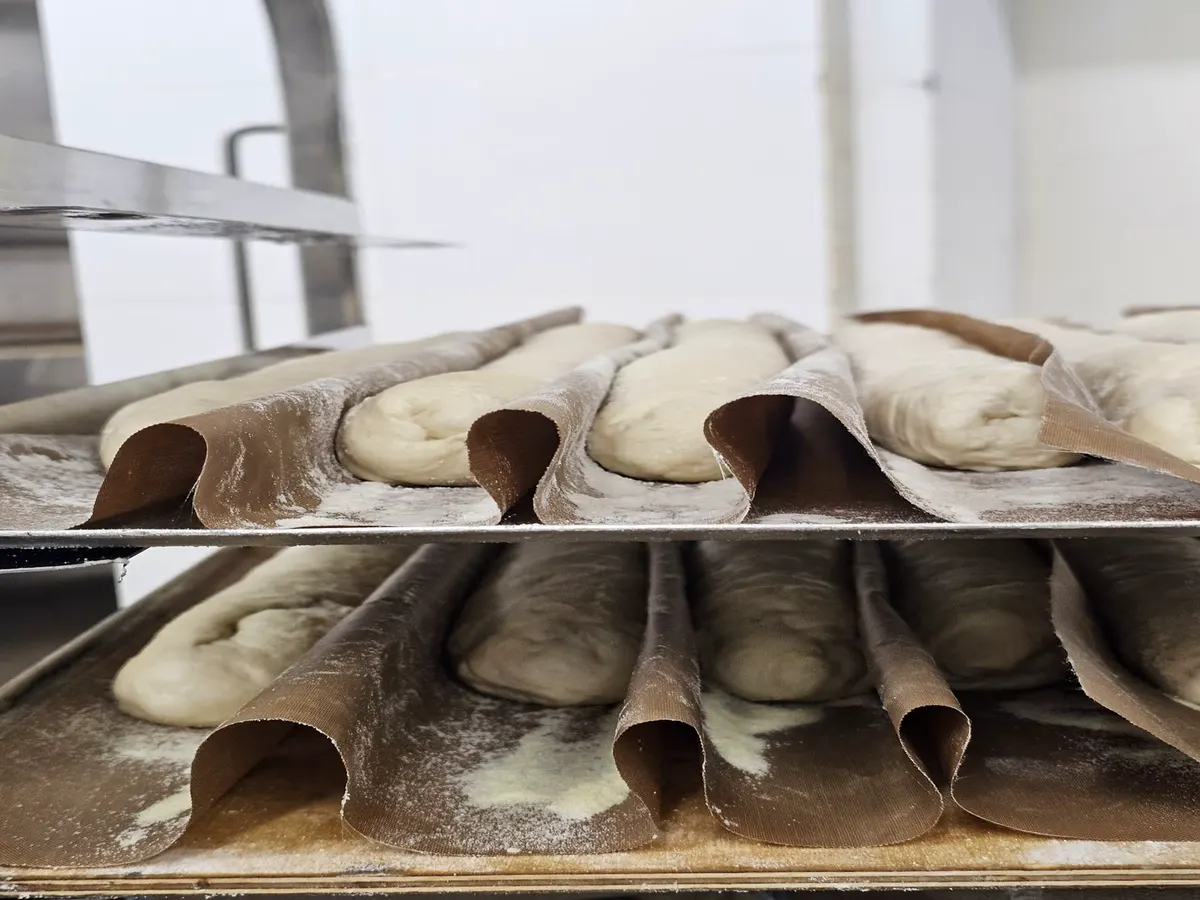
The main alternatives to a linen couche are plastic proofing baskets, perforated baguette trays, coated synthetic proofing cloths and PTFE-coated fiberglass sheets. For baguettes, batards and ciabatta, a textured PTFE sheet folds between the loaves like linen, does not absorb moisture, washes with water, and goes into the oven with the dough at up to 260°C, so the whole tray loads in one move.
Why a linen couche is hard to keep clean
Couche makers advise against routine washing. Matfer says to brush and dry the cloth and does not recommend hand or machine washing; SousChef (Charvet linen) says cold water only if you must. Washed linen shrinks and crumples (BakeryBits), and washing removes the flour in the weave that helps the dough release. Per Michael Kalanty, a couche must be completely dry before storage.
So the cloth is brushed but rarely washed, and sits under wet dough every day, often overnight in the retarder. Mold needs moisture, food and warmth; a couche has all three. Per the US EPA, "the key to mold control is moisture control", and mold grows in porous materials. The USDA notes that spores build up in dishcloths and towels, and that a musty smell means mold is spreading.
A PTFE sheet does not absorb moisture or flour, so it does not offer the conditions in which mold develops in linen. Whatever stays on it washes off.
Can a moldy couche be rescued?
In practice, no. A vinegar soak helps a little, but it takes work and does not fully solve the problem; in our experience the mold comes back within a few weeks. Research shows the limits: in a 2015 study, 4–4.2% vinegar inhibited Penicillium chrysogenum but not Aspergillus fumigatus, and antifungal agents penetrate porous materials poorly (Rogawansamy et al., IJERPH). Freezing does not kill mold; per the USDA it only inactivates it until it thaws. There is no evidence that baking soda kills mold. Chlorine is used to disinfect surfaces, but we do not recommend it on an absorbent cloth that touches dough directly.
What to do: take the moldy cloth out of production and replace it, check the couches stored with it, and dry every cloth fully before storage. The permanent fix is a surface that does not absorb. EU Regulation 852/2004 (Annex II) also asks for smooth, washable, non-absorbent surfaces unless the operator satisfies the authority that another material is appropriate.
Linen couche alternatives compared
Based on manufacturer instructions, bakery reports and material properties. There is no independent comparative data on these options.
| Option | Shapes | Cleaning | Loading the oven | Main limitation |
|---|---|---|---|---|
| Linen couche | Elongated, in pleats | Shake, brush, dry; makers advise against washing | Loaf by loaf, via flipping board | Absorbs moisture; mold risk, especially when retarding |
| Plastic proofing basket | All, including soft round loaves | Washes and dries fast | Each basket turned out by hand | Very wet dough sticks and pushes into the vents |
| Perforated baguette tray | Elongated, holds wet dough | Washable | Tray goes into the oven with the dough | Leaves bumps on the base; no hearth contact |
| Coated synthetic proofing cloth | Elongated, in pleats | Machine wash at 40°C, up to 90°C (per maker) | Loaf by loaf, via flipping board | Coating chemistry not disclosed |
| PTFE-coated fiberglass sheet | Elongated, in pleats | Shake or dry-brush after each bake; wash with water weekly to monthly | Whole sheet in one move, onto the deck | Dough surface dries less than on linen; flour lightly as needed |
Plastic baskets are the usual answer for round loaves: Empire Bakery switched from wicker after health officials raised concerns, when washing and drying wicker took 2–3 days. Perforated baguette trays go straight into the oven, but bakers report bumps on the bottom crust. Coated synthetic cloths such as ITT CLEANBAKE need no flouring, per the maker, but loaves still move one by one.
How GLISS sheets replace the couche
GLISS Artisan Hybrid is a textured PTFE-coated fiberglass sheet: a proofing cloth that goes into the oven with the dough.
- Folds between loaves like linen; replaces the couche, and for baguettes, batards, ciabatta and elongated loaves, the basket too.
- Proof, retard and bake on the same sheet, up to 260°C continuous, directly on the deck or stone.
- The whole tray loads in one move instead of loaf by loaf: by our estimate about 3× faster.
- Does not absorb moisture or flour, so it does not develop mold the way linen does. Shake or dry-brush after each bake; wash with water weekly to monthly.
- SGS-tested to FDA 21 CFR 177.1550, LFGB §30/31 and REACH SVHC; reports ready for inspection. Over a year of normal use at up to 260°C.
Artisan Hybrid 60×40 cm: ₪15 + VAT per sheet, packs of 25 · Artisan Large 80×60 cm: ₪30 + VAT · Trial kit: 15 sheets for ₪200 + VAT. Sold in Israel. All models and care details: GLISS overview.
Frequently asked questions
What can I use instead of a linen couche in a bakery?
For baguettes, batards and ciabatta: a textured PTFE-coated fiberglass sheet such as GLISS Artisan Hybrid, a coated synthetic proofing cloth, or a perforated baguette tray. Only the sheet and the tray go into the oven with the dough. For soft round loaves, use a plastic basket.
Should you wash a linen couche?
Not routinely. Matfer advises brushing and drying the cloth and does not recommend washing; SousChef says cold water only if you must. Washing removes the flour in the weave and shrinks the linen. Always dry it completely before storage.
How do you get mold out of a linen couche?
Not reliably. Vinegar affects only some mold species and penetrates porous cloth poorly, freezing only inactivates mold, and there is no evidence for baking soda. In our experience, mold comes back within a few weeks after a vinegar soak. Take the cloth out of production and replace it.
Does a PTFE sheet give the same crust as linen?
Close, not identical. The sheet does not absorb moisture, so the dough surface dries less than on linen and the crust looks slightly different. Flour the sheet lightly as needed, not too much; some products need no flour at all.
Can you retard dough overnight on a PTFE sheet?
Yes. The sheet does not absorb moisture and holds its pleats in the cooler, so the loaves keep their shape. Next day the whole sheet goes from the cooler to the loader and into the oven.
More in Hebrew: switching from linen couche · mold on linen couche · proofing basket alternatives.
Sources
- Matfer 118560 natural linen baker's couche: webstaurantstore.com
- SousChef — Baker's linen: souschef.co.uk
- Michael Kalanty — Caring for couches: ckbk.com
- BakeryBits — What is couche linen: bakerybits.co.uk
- US EPA — What are the basic mold cleanup steps?: epa.gov
- USDA FSIS — Molds on Food: fsis.usda.gov
- USDA FSIS — Freezing and Food Safety: fsis.usda.gov
- Rogawansamy et al. (2015), IJERPH — antifungal agents on porous materials: pmc.ncbi.nlm.nih.gov
- Regulation (EC) No 852/2004, Annex II: legislation.gov.uk
- Empire Bakery — Changing from wood to plastic proofing baskets: empirebake.com
- The Fresh Loaf — Couche vs baguette pan: thefreshloaf.com
- Chemours — Polymer fumes (PTFE temperature limits): teflon.com
- 21 CFR 177.1550 — Perfluorocarbon resins: law.cornell.edu